· ReadyStack
Worked example
Real numbers from this tool, line by line.
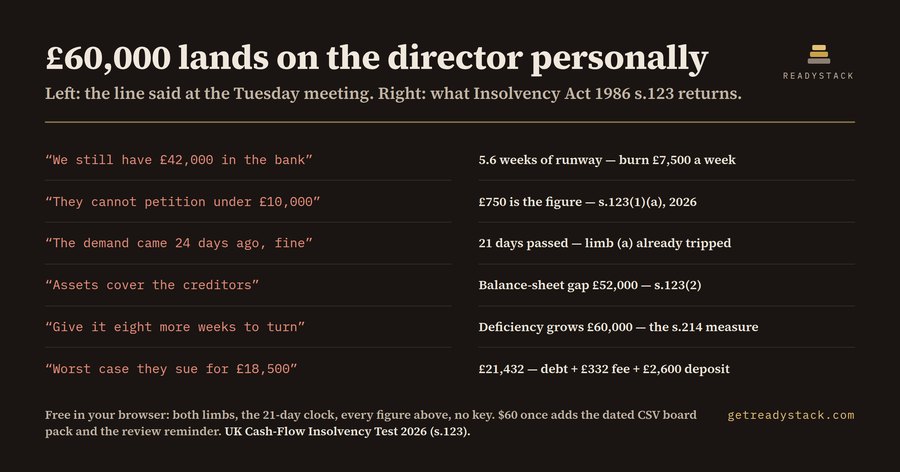
£60,000. That is what another eight weeks of trading adds to the deficiency of a UK owner-director whose company burns £7,500 a week — and it is the figure a liquidator measures a wrongful trading contribution by under section 214 of the Insolvency Act 1986.
The meeting where that number gets decided never feels like a legal meeting. There is £42,000 in the bank, the order book looks better after Christmas, and a demand that arrived twenty-four days ago is in the tray. Everyone agrees to give it two more months.
Three things in that room are wrong, and a chatbot confirms all three.
The threshold is not £10,000. That figure was a temporary measure of 2020 to 2022 and it has been repeated by language models ever since. The standing figure in s.123(1)(a) is a written demand for a sum exceeding £750 which the company neglects to pay for 21 days. Twenty-four days is past it. The company is already deemed unable to pay its debts; nobody has to prove anything about the bank balance.
The bank balance is not the test. s.123(1)(e) asks whether the company can pay its debts as they fall due. £42,000 against a net weekly outflow of £7,500 is 5.6 weeks, which is inside the thirteen-week horizon every insolvency practitioner looks at first.
Assets are not the other test. s.123(2) compares the value of assets with liabilities, taking into account contingent and prospective liabilities. Realisable assets of £96,000 against total liabilities of £148,000 is a gap of £52,000 — the second limb, tripped as well.
What the arithmetic actually says
Those are the default figures in the free tool: an ordinary small company having an ordinary bad quarter. Type them in and the answer comes back in one screen: burn £7,500 a week, 5.6 weeks of runway, limb (a) tripped with 0 days left on the 21-day clock, a balance-sheet gap of £52,000, and £60,000 of increase in net deficiency over the eight weeks the meeting just voted for.
The last line is the one that matters personally. A director's liability under s.214 is not a fine and not a share of the debt; it is a contribution measured by how much worse the position got after the point where insolvent liquidation stopped being avoidable. Eight weeks of £7,500 is £60,000, and it is owed by the people in the room, not by the company.
There is a fourth number nobody costs. If the creditor owed £18,500 petitions, the court fee is £332 and the Official Receiver's deposit is £2,600: the figure being chased becomes £21,432, and a liquidator then has a duty to report on the directors' conduct.
Why a chatbot cannot do this
It cannot see your forecast. Ask it and it returns a yes or a no from a memory of the law that still contains the expired threshold. What a director needs is not a verdict, it is a number: how much waiting costs, per week, in their own money.
What this is
A browser extension and a free web page that share one calculation. Both limbs of s.123, the 21-day clock, the runway, the dry-out date, the deficiency figure, the petition claim and a written verdict. Free, keyless, unlimited, no watermark. The paid layer is a different axis, not a bigger answer: a dated CSV of the exact run for the board minute, and a reminder before the review date you typed — because a solvency test is worth nothing if it is run once.
It is a calculator, not legal advice. A licensed insolvency practitioner's pre-appointment work is billed at time cost, and the creditors' voluntary liquidation that follows a missed cash-flow test runs £3,000 to £8,000 plus VAT. The test takes ninety seconds.
Questions people ask
What does this actually do?
It runs the two tests in section 123 of the Insolvency Act 1986 on figures you type. The cash-flow limb compares your 13-week receipts and payments against cash in hand; the balance-sheet limb compares realisable assets against total liabilities. It also prices what another eight weeks of trading adds to the deficiency.
Who is it for?
UK owner-directors of small limited companies, and the bookkeepers and accountants who keep their weekly cash forecasts. It is for the fortnight when a demand has landed, the bank balance still looks survivable, and somebody has to decide whether trading on is defensible. It is a calculation, not legal advice.
Why will a free chatbot not do this?
Chatbots still repeat the temporary ten thousand pound winding-up threshold from the 2020 to 2022 measures, when the standing figure under s.123(1)(a) is a sum exceeding seven hundred and fifty pounds unpaid for 21 days. They also cannot see your forecast, so they answer yes or no instead of a number.
What is free and what costs money?
Every calculation is free, keyless and unlimited: both limbs, the 21-day clock, the runway, the dry-out date, the deficiency figure, the petition claim and the verdict. Twenty-nine dollars once adds a different axis, not a bigger answer: a dated CSV you can keep, and a reminder before your review date.
What would this cost with a person?
A licensed insolvency practitioner's pre-appointment work is billed at time cost, and the creditors' voluntary liquidation that follows a missed cash-flow test runs three to eight thousand pounds plus VAT in 2026. A creditor's own petition adds a court fee of three hundred and thirty-two pounds and a deposit of two thousand six hundred.
Ask about this tool
One question, answered by the person who built it. Your email only if you want the answer sent.